Collection: Surface Aerators
-
-
-
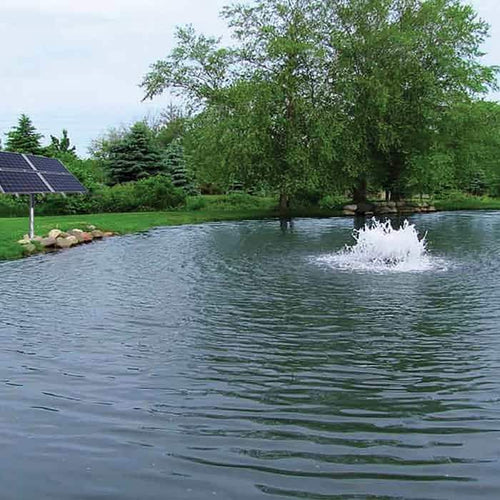
- Scott Aerator 3/4 Hp Boilermaker Floating Solar Pond Aerator
- Regular price
- $7,419.03
- Sale price
- $7,419.03


Surface Aerators
Surface aerators are engineered for maximum oxygen transfer and active water mixing. They are ideal for ponds and lakes where dissolved oxygen, fish health, and rapid recovery matter more than decorative appearance.
Is a Surface Aerator Right for Your Lake?
Best Choice If
- You need fast oxygen recovery
- Your pond experiences fish kills or oxygen crashes
- You want aggressive circulation near the surface
- Function matters more than appearance
Consider Another Option If
- You want decorative spray patterns → Aerating Fountains
- Your lake is deep or stratified → Diffused Aeration Systems
- You want appearance only → Floating Fountains
How Surface Aerators Work
Surface aerators pull water from just below the surface and aggressively agitate it, breaking surface tension and entraining atmospheric air directly into the water. This creates rapid oxygen absorption and strong lateral circulation.
- Delivers dissolved oxygen quickly where fish need it most
- Prevents stagnant surface conditions and low-oxygen zones
- Helps stabilize water quality during hot weather and high biological load
Best for: oxygen insurance, fish protection, odor reduction, and high-demand ponds/lakes.
Surface Aerators vs Other Aeration Types
Surface Aerator vs Aerating Fountain
| Category | Surface Aerator | Aerating Fountain |
|---|---|---|
| Primary goal | Maximum oxygen transfer + aggressive circulation | Aesthetics first, aeration second |
| Oxygen transfer focus | Optimized for fast DO recovery | Highly pattern/nozzle dependent |
| Mixing & circulation | Strong lateral push and surface mixing | Can be moderate; often more localized |
| Best use cases | Fish-kill prevention, odor control, high-bioload ponds | HOA/showpiece lakes where appearance matters |
| Look | Utilitarian | Decorative spray patterns |
Surface Aerator vs Fountain vs Diffused Aeration
| Category | Surface Aerator | Aerating Fountain | Diffused (Bottom) Aeration |
|---|---|---|---|
| Best at | Fast oxygen delivery + surface-zone mixing | Beauty + moderate aeration | Whole-lake destratification |
| Oxygen response speed | Excellent | Moderate | Slower at surface |
| Depth impact | Primarily upper water column | Upper water column | Best in deeper water |
| Emergency response | Excellent | Fair | Typically slower |
| Typical strategy | Primary oxygen system or oxygen “insurance” | Aesthetic upgrade with some aeration | Deep-lake foundation (often paired with a surface unit) |
Oxygen Transfer Performance Metrics
Standard Metric Used: SAE (Standard Aeration Efficiency)
Measured as lb O₂ / hp·hr under standardized clean-water test conditions
| Aeration Type | Typical SAE Range* | Operational Meaning |
|---|---|---|
| Surface Aerators | ~1.25 – 2.5 lb O₂ / hp·hr | High oxygen transfer and rapid DO recovery near the surface |
| High-Performance Surface Aerators | Up to ~3.0 – 3.3 lb O₂ / hp·hr | Maximum oxygen delivery when oxygen transfer is the priority |
| Aerating Fountains | ~0.9 – 1.5 lb O₂ / hp·hr | Performance varies widely based on spray pattern and aesthetics |
| Diffused Aeration (Bottom) | ~1.5 – 2.7 lb O₂ / hp·hr (depth-dependent) | Efficient at depth; typically slower surface DO response |
*Ranges reflect commonly published, independently tested values across major manufacturers.
Performance Disclaimer: Oxygen transfer values are provided for comparison purposes only. Actual performance varies based on water depth, temperature, system design, placement, and operating conditions.
Which Aeration System Is Right for Your Lake?
Choose a Surface Aerator if you want:
- Fast dissolved oxygen recovery
- Protection against fish kills
- Strong surface mixing and circulation
- Reliable oxygen delivery in hot weather
Choose an Aerating Fountain if you want:
- A visual centerpiece
- Moderate aeration with aesthetic appeal
- A solution optimized for appearance
Choose Diffused Aeration if you want:
- Whole-lake destratification
- Improved bottom-water conditions
- A long-term foundation for deep lakes
Rule of thumb:
Shallow ponds with oxygen crashes → Surface Aerator
HOA lakes where beauty matters → Aerating Fountain
Deep stratified lakes → Diffused Aeration (often paired with a surface unit)
- Commercial-grade motors & components
- Designed for continuous operation
- Manufacturer warranties included
- Free shipping on qualifying orders
Shop Surface Aerators
Surface aerators are designed for maximum oxygen transfer, aggressive circulation, and fast dissolved oxygen recovery—making them ideal for ponds and lakes where performance matters more than appearance.
- ✔ Built for oxygen delivery, not just aesthetics
- ✔ Proven solution for fish-kill prevention and oxygen crashes
- ✔ Options available for small ponds to large lakes
- ✔ Expert support available to help you size and configure correctly
Not sure what size you need? Get sizing help →
Surface Aerator FAQs
What is the difference between a surface aerator and a fountain?
A surface aerator is built for oxygen transfer and circulation performance—it aggressively mixes water at the surface to help restore dissolved oxygen quickly. An aerating fountain prioritizes appearance and provides moderate aeration that can vary by spray pattern and nozzle setup.
What is the difference between a surface aerator and a diffuser (diffused aeration)?
Surface aerators deliver oxygen and mixing primarily in the upper water column and are excellent for fast dissolved oxygen recovery. Diffused (bottom) aeration uses compressed air and diffuser plates on the bottom to circulate water upward, helping with whole-lake destratification—especially in deeper ponds and lakes.
How do I size a surface aerator?
Sizing depends on surface area, depth, temperature profile, and biological/organic load. As a general guideline, many ponds require approximately 1 to 1.5 horsepower per surface acre, though irregular pond shapes, coves, or high oxygen demand may require additional units. For best results, sizing should account for circulation coverage—not just acreage.
Do surface aerators replace bottom aeration?
Not usually. Surface aerators excel at surface-zone oxygen delivery and rapid dissolved oxygen recovery. Diffused aeration is typically better for deep destratification.
Are surface aerators safe for fish?
Yes. They’re commonly used specifically to help prevent fish kills by improving dissolved oxygen—especially during hot weather or oxygen crashes.
Are surface aerators noisy?
They can be more audible than decorative fountains, but noise decreases significantly with distance and proper placement.
Can surface aerators run year-round?
Many can, but seasonal operation depends on climate, goals (oxygen vs circulation), and manufacturer recommendations—especially where ice is present.